


Fio guia PTCA para intervenção coronária
-
 2021-07-07
-
LEPU


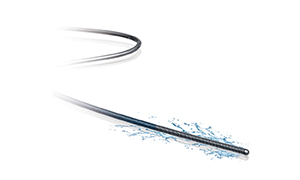
There are Tipos de fios-guia PTCA that can be used for coronary intervention. The success of the operation depends on the ability to manipulate the guide wire into and through coronary artery stenosis, as well as the ability of the guide wire as a subsequent device to deliver the track. The ideal guide wire can be easily twisted and manipulated through tortuous coronary arteries without causing trauma, but still provides sufficient rigidity for the delivery of relatively inflexible stents.
Now, almost all PTCA wires are 0.014 inches in diameter. Most operators will choose a general or "workhorse" line for most interventions. Provide "extra support", hydrophilic coating or tapered tip PTCA wire, which can be used for special situations, such as blood vessel bending, calcification and complete occlusion.
1. The Fio guia PTCA is made of stainless steel or nitinol center shaft
Nitinol core wire is more resistant to kinking than stainless steel core wire, with a smaller torque response. Various coatings are "sprayed" or "dripped" onto the wires to reduce friction. The strength of the tip varies from wire to wire, resulting in a stiffer or softer spring coil tip.
The length of the core wire taper will also change the characteristics of the wire: if the Fio guia PTCA core wire extends to the distal end, this will cause the wire tip to be harder than the core wire rapidly becomes thinner in front of the tip, providing the former with a crossover technical advantage. For chronic complete occlusion, the hydrophilic polymer coating tip reduces friction, making it easier to pass through highly narrow lesions and tortuous anatomical structures. However, this advantage comes at the cost of increasing the risk of line perforation and interlayer.
2. Torque response is an important feature of Fio guia PTCA
A resposta do torque refere-se à transmissão de rotação do operador para a ponta do fio-guia PTCA. A resposta de torque um para um é desejável, e esse recurso é um dos recursos mais importantes para os médicos ao escolher um fio. A estrutura do núcleo à ponta melhora o controle do torque, e o projeto específico do atarraxamento igualmente afeta a resposta do torque.
It is not uncommon for devices to be challenging to deliver in curved, angled, and calcified blood vessels. In this case, starting with the "extra support" line, or replacing the "main force" line with the same line may also help, because the increased rigidity of the support line may allow the conveying device in situations where the "main force" line cannot be achieved. However, the additional support wire is unlikely to follow the path of the blood vessel and may cause wire bias, further hindering device delivery. In addition, advancing the second wire (the "buddy wire") may help straighten the zigzag section and facilitate the delivery device.
Both of these techniques can significantly correct previously highly angled coronary arteries, leading to the development of so-called "pseudo-lesions". These should not be mistaken for true stenosis. Once the natural blood vessel angle is restored, withdrawing the guide wire at the proximal end of the bend will confirm that these are not true lesions.