


Quais são os tipos de cateteres balão?
-
 2022-10-25
-
LEPU


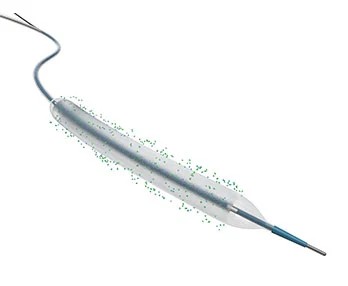
On January 16th, 1964, Dotter and Judkins performed the world's first lower limb vascular angioplasty on an elderly female patient using a balloon catheter. Thirteen years later, Gruentzig performed the world's first coronary angioplasty using a balloon catheter. Today, balloon dilation catheters are widely used for the diagnosis and treatment of cardiovascular diseases. Reviewing the development of balloon dilation catheter technology provides many insights for our current and future work. Next, let's take a look at the types of balloon catheters.
Cateter balão troca 1.Rapid
The rapid exchange balloon dilation catheter is currently the most widely used type of balloon dilation catheter in percutaneous coronary intervention (PCI). The catheter has a side hole 25cm from the tip of the balloon, through which the guide wire is inserted and emerges from the side hole when it is inserted through the top of the balloon. This design greatly facilitates the operation of the operator and saves time. The structure of the rapid exchange balloon is also different from other types of balloons in that it includes a connection segment between the balloon and the push rod, occasionally leading to rupture. Both the balloon and guide wire are operated by one person, resulting in an ideal imaging effect. The disadvantage of this type of balloon catheter is that if the entire balloon system is not removed, the guide wire cannot be replaced. If an extension guide wire is not used, the OTW balloon cannot be replaced, and the push force is slightly reduced, and the tracking is slightly worse.
2. Cateter do balão do Sobre-fio
The over-the-wire balloon dilation catheter (OTW) was first used in PTCA in 1982. It can be used for CTO lesions or when guide wire exchange is required, as well as for interventricular septal chemical ablation and central cavity pressure measurement and blood sampling. Currently, OTW balloons are rarely used clinically. The advantages of the OTW balloon dilation catheter include easy exchange of guide wires and good tracking. When the guide wire is difficult to pass through the occlusive lesion, the OTW balloon can provide additional support, similar to the role of a microcatheter. If the guide wire still cannot pass through the lesion, the OTW balloon dilation catheter can be used as a transmission catheter to exchange other guide wires. After the guide wire passes through the lesion, the OTW balloon dilation catheter can also be used for distal angiography to facilitate judging whether the guide wire is located in the true cavity. Therefore, the OTW balloon dilation catheter still has certain advantages in handling CTO lesions. The disadvantage of this type of balloon catheter is that the balloon size is slightly larger and the length of the steel wire is 300 cm, requiring cooperation between two operators.
3. cateter fixo do balão do guidewire
O cateter de dilatação com balão tem um fio guia plástico flexível fixado na parte superior do cateter com 2 cm de comprimento. Dentre os cateteres de dilatação por balão comumente utilizados, tem a menor forma externa, o que aumenta a taxa de travessia da lesão e resulta em um efeito de imagem ideal, e requer apenas uma pessoa para operá-lo. No entanto, quando o cateter entra no vaso sanguíneo alvo, ele precisa ser empurrado para a frente enquanto gira em ambas as direções, tornando o cateter propenso à quebra. Não pode se mover independentemente e não pode trocar fios guia. Basicamente, não é mais usado clinicamente.
4. Tipos de cateteres balão de perfusão
O cateter de dilatação com balão de perfusão possui múltiplos orifícios laterais nas extremidades proximal e distal, portanto, quando o balão é inflado, o fluxo sanguíneo ainda pode entrar na extremidade distal doente.
Quando a pressão aórtica média é de 80 mmHg, o fluxo sanguíneo distal ainda pode atingir 40-60 ml/min. Quando a pressão contínua do balão é necessária para tratar complicações como perfuração da artéria coronária, o uso de cateteres de dilatação balão de perfusão tem certas vantagens. A principal desvantagem é que o cateter é relativamente espesso e tem pouca capacidade de atravessar lesões.
5. Tipos especiais de cateteres balão
Os tipos especiais de balões atualmente utilizados na prática clínica incluem principalmente balões de duplo fio, balões de corte, balões farmacológicos, etc. Essencialmente, esses três tipos de balões pertencem a cateteres de dilatação por balão de troca rápida, mas possuem funções especiais que diferem dos balões convencionais de troca rápida.
O diâmetro externo do balão de fio duplo é semelhante ao de um balão regular, e há um lúmen interno no final do balão para guiar a forma do fio. Além disso, há um fio fixo na superfície do balão, localizado na posição de 180 ° em ambos os lados do balão a partir do fio guia.
O balão de fio duplo pode cortar o tecido da placa de forma regular, com danos mínimos ao endotélio e garantindo que o balão não se desloque. O balão de corte é um produto que combina a tecnologia de micro corte com a dilatação do balão. Os balões de corte atualmente utilizados clinicamente são produtos de terceira geração, que apresentam melhor passabilidade, podem atingir dilatação completa com menor pressão, apresentam baixas taxas de rasgamento irregular da íntima vascular e baixas taxas de re-estreitamento a longo prazo.
O balão farmacológico é um produto que combina a tecnologia tradicional de dilatação do balão com a tecnologia farmacológico, e está gradualmente mostrando sua superioridade como um suplemento eficaz ao stent. O balão farmacológico pode evitar efeitos colaterais causados por stents metálicos e transportadores de polímero, e pode aplicar medicamentos em áreas específicas da parede do vaso sanguíneo doente para controlar o re-estreitamento.